Michael Cody brings over 32 years of architectural and design expertise to the Ware Malcomb team. He serves as practice leader, director, industrial cold & food. He has significant experience in all facets of development, architecture and design, including leadership, project management, development, entitlement public presentations and process, contract documents, contract administration and design presentations. Michael has in-depth knowledge of computer aided drafting, using the most current versions of Revit and AutoCAD and a variety of computer software. He has worked on a wide range of design projects including industrial cold storage, high rise, historic preservation, renovation, residential, hospitality, office, recreational, mixed-use and healthcare.

Designing Sausage Processing Facilities for Safety, Flow & Efficiency
Thoughtful design of sausage processing facilities eliminates inefficiencies by aligning the building with the sequence of operations. Placing spaces in the correct order gives architects an opportunity to design a building that itself becomes a tool for operational efficiency. Courtesy Portra / E+ / Getty Images.
Designing a sausage processing and storage facility is more complex than just fitting the right equipment into a building. It involves understanding how ingredients move, how employees work, how to maintain food safety at every step and integrating operational efficiency into the design from the very beginning.
At the core of any successful sausage processing facility is a precise, logical flow from raw ingredients to finished product. Sausage production begins with raw meat, most commonly pork, but sometimes beef, lamb, or poultry, which arrives at a facility under strict cold chain requirements. From the moment the raw meat hits the dock, the building must support uninterrupted temperature control and prevent any opportunity for cross-contamination. As architects, we play a critical role in designing a building to best prevent food safety risks and enhance operational efficiency.
How strategic layout and temperature control influence production.
Flow & Food Safety as a Design Driver
A well-designed facility starts with separation. Raw materials, in-process products and ready-to-eat (RTE) items must each have clearly defined zones. Typically, this begins with a dedicated cold dock for meat receiving, directly connected to a raw ingredient cooler. This layout allows meat to move immediately from the truck to refrigerated or frozen storage without exposure to ambient conditions.
From there, the flow continues into chilled production areas, where grinding, seasoning and stuffing take place. These production rooms are temperature-controlled environments, often operating at around 40–50° Fahrenheit to maintain product integrity and slow bacterial growth. Designing adjacency between these spaces: cooler to grinder, grinder to seasoning, seasoning to stuffing, reduces unnecessary handling, shortens travel distances, optimizes employee productivity, and minimizes risk.
Just as important is what doesn’tcross paths. Cooked, cured, or smoked sausages that are considered RTE must never intersect with the raw product flow. To avoid cross-contamination, the design should integrate separate coolers, isolated packaging zones – and in many cases – entirely distinct circulation paths for people, equipment and materials.
Food safety is embedded in the building itself. Sausage facilities often include multiple coolers and freezers, each serving a specific purpose: raw meat storage, ingredient storage (such as casings), in-process holding, ready-to-eat product and frozen finished goods.
Beyond temperature control, finishes and detailing matter. Floors, walls and wall-to-floor transitions must be designed to withstand frequent washdowns using pressure washers and cleaning chemicals. Proper slopes, durable coatings and seamless transitions help prevent standing water, residue buildup and mold growth. These details directly support sanitation protocols that can be performed multiple times per day without shutting down the entire operation.
Operational continuity is also a key consideration. Facilities are often designed with multiple production rooms so one space can be shut down for cleaning while others remain operational. This flexibility supports food safety requirements without sacrificing productivity.
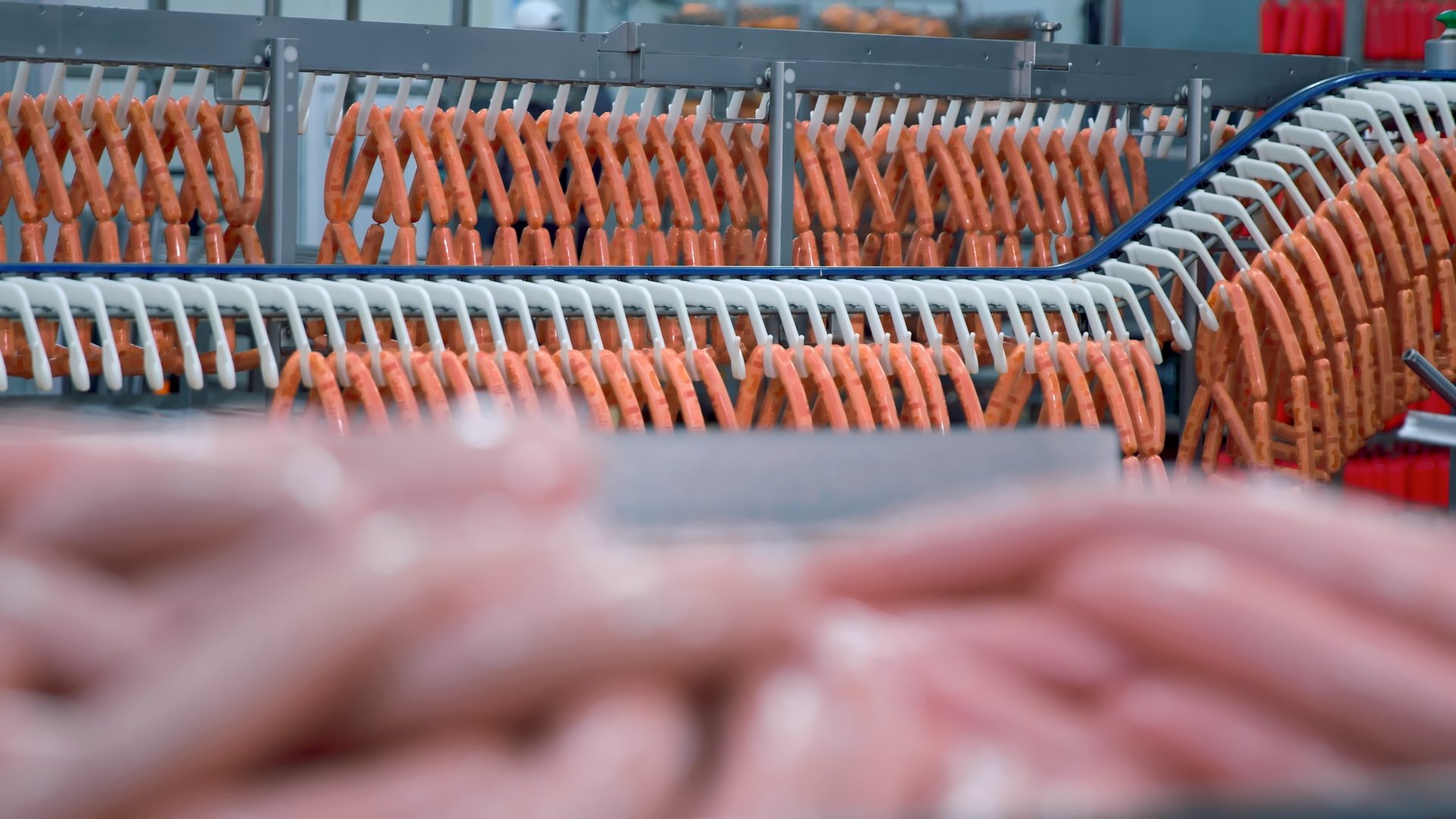
To avoid cross-contamination, the design should integrate separate coolers, isolated packaging zones – and in many cases – entirely distinct circulation paths for people, equipment and materials. Courtesy alexey_ds / E+ / Getty Images.
Controlling Operations & Efficiency
Operational control extends beyond sanitation. The layout of docks, corridors and production rooms determines how people and products move, and how efficiently they do so. Poorly planned facilities force raw products to travel past ovens or finished goods, increasing risk and potentially wasting labor. Thoughtful design eliminates these inefficiencies by aligning the building with the sequence of operations.
Increasingly, automation plays a role as well. Automated Guided Vehicles (AGVs) are becoming more common in meat processing facilities, transporting raw products and ingredients and product through predefined routes. Supporting AGVs would entail providing proper clearances, smooth floor surfaces and predictable circulation paths. The result is fewer manual transfers, reduced labor strain and more consistent operations.
Technology also influences planning at a higher level. Production volumes fluctuate seasonally. Holidays and summer grilling season drive demand, and many operators use data and AI-driven forecasting to plan throughput. Facilities must be sized and organized to handle peak demand efficiently without overbuilding storage or production areas that sit idle for much of the year.
Efficiency in a sausage facility is measured in physical steps eliminated, risks reduced and time saved. Placing spaces in the correct order: dock to cooler, cooler to production, production to packaging, packaging to freezer or outbound dock, gives architects an opportunity to design a building that itself becomes a tool for operational efficiency.
Throughput, not just square footage, drives design decisions. Some producers want only a week’s worth of storage on site to match end-user demands, shipping products quickly to third-party cold storage or distribution centers. Others prefer to hold more inventory in-house. Understanding these operational preferences early allows the design team to right-size coolers, freezers and production areas to match real-world use.
Ultimately, the most successful facilities are those where architecture supports the craft. Sausage making is both science and art: grind size, seasoning blends, curing methods and cooking processes vary widely by product and tradition. A well-designed building respects that complexity while ensuring safety, efficiency and adaptability.
When the process drives the design, the result is a facility that protects food safety, supports workers and delivers a consistent, high-quality product from raw ingredients to finished sausage.